Why a Protein Bar Before Training Works for Some People and Wrecks Others
Quick Answer: Whether a pre-workout protein bar sits well comes down to three label items: fiber (especially chicory root or inulin), sugar alcohols (erythritol, maltitol, sorbitol), and fat. All three slow gastric emptying and ferment in the gut, which is fine at your desk and miserable during a hard session. A lower-fiber, lower-sugar-alcohol, lower-fat bar eaten 60 to 90 minutes out works for most people.
Your friend eats a bar in the car and trains fine. You eat the same bar and spend the first fifteen minutes regretting it.
You are not more sensitive as a person so much as the bar is a different food for you at that moment. Pre-training digestion is an unusually demanding context, and bars are formulated for convenience rather than for it.
Here is what on the label predicts the outcome.

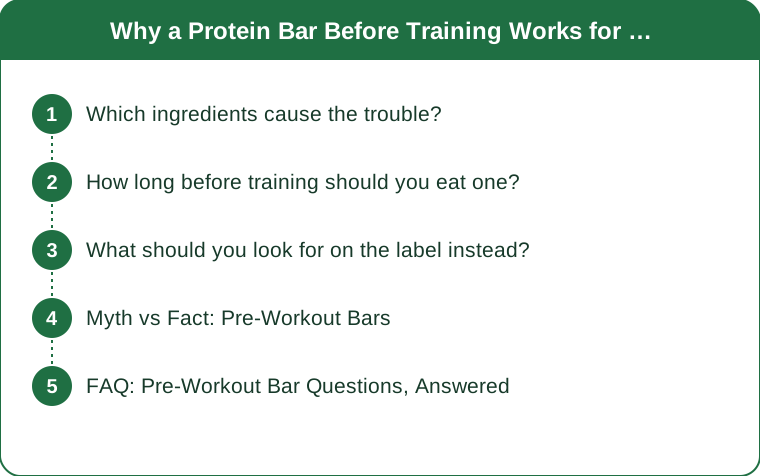
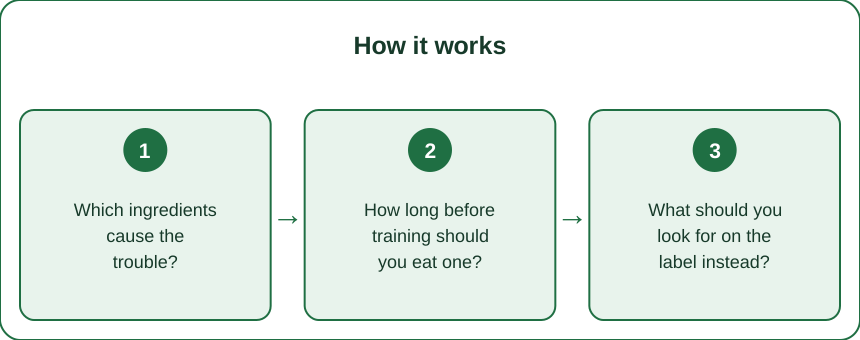
Which ingredients cause the trouble?
Fiber, sugar alcohols, and fat — in roughly that order for pre-workout distress.
Added fiber is the biggest single culprit. Chicory root fiber and inulin are used to boost fiber numbers and add sweetness without sugar. They ferment in the large intestine, producing gas. A bar with 10 g of added chicory fiber can be genuinely unpleasant 30 minutes into a run while being completely fine on a rest day.
Sugar alcohols pull water into the gut. Maltitol and sorbitol are the worst offenders; erythritol is generally better tolerated but not universally. The osmotic effect means fluid in the intestine at exactly the moment blood flow is being redirected to your muscles.
Fat slows everything down. A bar with 15 g of fat empties from your stomach considerably more slowly than one with 6 g. Slow emptying plus jostling equals the heavy, sloshing sensation people describe.
Protein type matters less than expected. Whey, casein, and plant blends all work for most people pre-training. The exception is very high casein content, which is deliberately slow to digest and better suited to before bed than before a session.
How long before training should you eat one?
60 to 90 minutes for most bars. 30 minutes only for a low-fiber, low-fat, low-sugar-alcohol bar.
The bar is a small meal, not a gel. Most bars have 200 to 250 calories with real fat and fiber. That is a snack-sized meal and it needs snack-sized meal timing.
Blood flow gets redirected during exercise. Splanchnic blood flow drops substantially during hard effort, which slows digestion further. Anything still in your stomach when that happens stays there.
Intensity changes the tolerance window. Easy walking or steady cycling is quite forgiving. Running, high-intensity intervals, and anything with jumping or inversions demand a mostly empty stomach.
Test on easy days. Never trial a new bar before a session that matters. Try it before an easy walk first, then a moderate session, then decide.

What should you look for on the label instead?
Simple targets that predict good tolerance.
Fiber under about 5 g, and check the source. Fiber from nuts, oats, and dates is far better tolerated than isolated chicory root or inulin. Read the ingredient list, not just the fiber number.
Sugar alcohols under about 5 g, ideally none. If maltitol or sorbitol appears high on the ingredient list, treat that bar as a rest-day bar.
Fat under about 8 g for pre-workout. Higher-fat bars are excellent between meals and poor before training.
Some real carbohydrate. A bar with 20 to 30 g of carbohydrate is genuinely useful before a session. A near-zero-carb, high-fiber bar gives you the digestive cost of eating with little of the fuel benefit.
Around 15 to 20 g of protein is plenty pre-workout. More is not better here; it simply adds to what has to be digested.
Myth vs Fact: Pre-Workout Bars
Myth: If it is a protein bar, it is a good pre-workout choice. Fact: most bars are formulated as meal replacements or snacks. Pre-workout is a specific and much more demanding use case.
Myth: High fiber means healthier. Fact: for general diet quality, more fiber is usually good. Immediately before hard exercise it is the leading cause of gut distress. Context decides.
Myth: Sugar before training is bad. Fact: readily available carbohydrate is exactly what is useful before a session. The sugar-free, fiber-loaded, sugar-alcohol-sweetened alternative is far more likely to cause problems.
Myth: You will adapt if you keep trying. Fact: gut training is real for endurance athletes and does work for carbohydrate tolerance. Sugar alcohol and fermentable fiber sensitivity adapts much less reliably.
Myth: Everyone needs to eat before training. Fact: plenty of people train well fasted for sessions under an hour. If bars consistently bother you, that is a legitimate option rather than a compromise.
FAQ: Pre-Workout Bar Questions, Answered
What is the simplest pre-workout food if bars do not work for me?
A banana with a small amount of yogurt, or a slice of toast with honey. Low fat, low fiber, easy carbohydrate, and about 30 to 45 minutes of lead time. It is unglamorous and it works for almost everyone.
Can I eat half a bar instead?
Yes, and it is an underrated fix. Half a bar 45 minutes out and the other half afterward gives you fuel without the digestive load, and it costs nothing to try.
Why does the same bar bother me some days and not others?
Sleep, stress, caffeine, heat, and how hard you are training all shift gut tolerance. Hot weather and high-intensity days are when a marginal bar reliably becomes a problem.
This is general information, not medical advice. Persistent digestive symptoms are worth discussing with a healthcare professional.
TL;DR:
- Three label items decide it: added fiber (chicory root, inulin), sugar alcohols (maltitol, sorbitol), and fat.
- Target under 5 g fiber from whole-food sources, minimal sugar alcohols, under 8 g fat, and 20 to 30 g of real carbohydrate.
- Eat it 60 to 90 minutes before training; 30 minutes only for a genuinely light bar.
- Higher intensity and hot weather shrink your tolerance window considerably.
- Half a bar before and half after is a simple and effective fix.
- Never trial a new bar before a session that matters.
A protein bar is a small meal in a wrapper, and pre-workout is the least forgiving moment to eat a small meal. Read three lines on the label, adjust the timing, and the bar that used to wreck your sessions usually becomes perfectly usable.
Keep Reading
This article is for general informational purposes only and is not medical advice. Always consult a qualified health professional for guidance specific to you.