Why Does a Protein Bar Eaten in the Car Land Differently?
Quick Answer: A bar eaten while driving is typically eaten faster, chewed less, and without the sensory attention that drives satiety signals — so the same 20g of protein leaves you hungrier than it would at a table. Speed is the main variable: bars eaten in under two minutes register poorly regardless of nutrition label. Slowing to five minutes and drinking water alongside recovers most of the difference.
You eat the same bar at your desk and it holds you until dinner.
You eat it in the car on the way home and you are raiding the kitchen ten minutes after you park.
The label did not change. The conditions did.

Why does the same bar behave differently?
Satiety is not purely chemical. It is built from several signals arriving over roughly twenty minutes, and only some of them come from the nutrients themselves.
The main contributors are stomach stretch, nutrient detection in the gut, hormonal responses, and — this is the one people discount — the sensory and cognitive experience of having eaten.
That last one is doing real work. Your brain keeps a record of the meal, and that record influences how hungry you feel later. Eating while your attention is fully on something else produces a weaker record. Studies on distracted eating consistently find that people eat more at the next meal after a distracted one, not just during it.
Driving is close to a worst case: your attention is legitimately elsewhere, you are not looking at the food, and you are chewing on autopilot.
So you get the full nutritional content and a fraction of the satiety response. The protein was absorbed. The meal barely registered.
How much does eating speed matter?
More than almost any other variable here.
The satiety signals that tell you a meal happened take roughly fifteen to twenty minutes to fully arrive. Anything eaten faster than that outruns its own feedback.
A protein bar eaten at a table takes most people four to six minutes. The same bar in a car frequently takes ninety seconds — three or four large bites at traffic lights, done before the next turn.
That is not a minor difference. It changes the bar from something your body processes as a small meal into something it processes as barely an event.
The practical version:
- Under two minutes: minimal satiety response. Expect to be hungry within the hour.
- Four to six minutes: a normal snack response. This is what the bar was designed around.
- Ten minutes or more: unnecessary, and most people cannot sustain it with a bar anyway.
If you only change one thing, change the speed. It costs nothing and it is the largest single lever.
What nobody tells you about chewing a bar less
Bars vary enormously in how much chewing they demand, and that turns out to matter for reasons beyond texture preference.
Dense, chewy bars require sustained effort, which naturally slows you down and increases the oral processing time. Soft, cakey, or coated bars can be swallowed in three bites with minimal work.
Chewing itself contributes to satiety through several routes — it extends the eating duration, it increases the sensory exposure to flavor, and it starts the digestive cascade earlier. This is part of why the same calories in solid form fill you up more than in liquid form.
So the soft, pleasant, easy-to-eat bar is often the one that leaves you least satisfied, which is exactly backwards from how people choose bars. Palatability and satiety are frequently in tension.
This interacts with the car problem badly. In a car you want something easy to eat one-handed with minimal mess — which pushes you toward exactly the soft, coated, fast-to-eat bars that satisfy least.
If your car bar is a soft coated one and you are always hungry afterward, that is two compounding factors, not one.
Does what you drink with it change anything?
Yes, and it is the second easiest fix after speed.
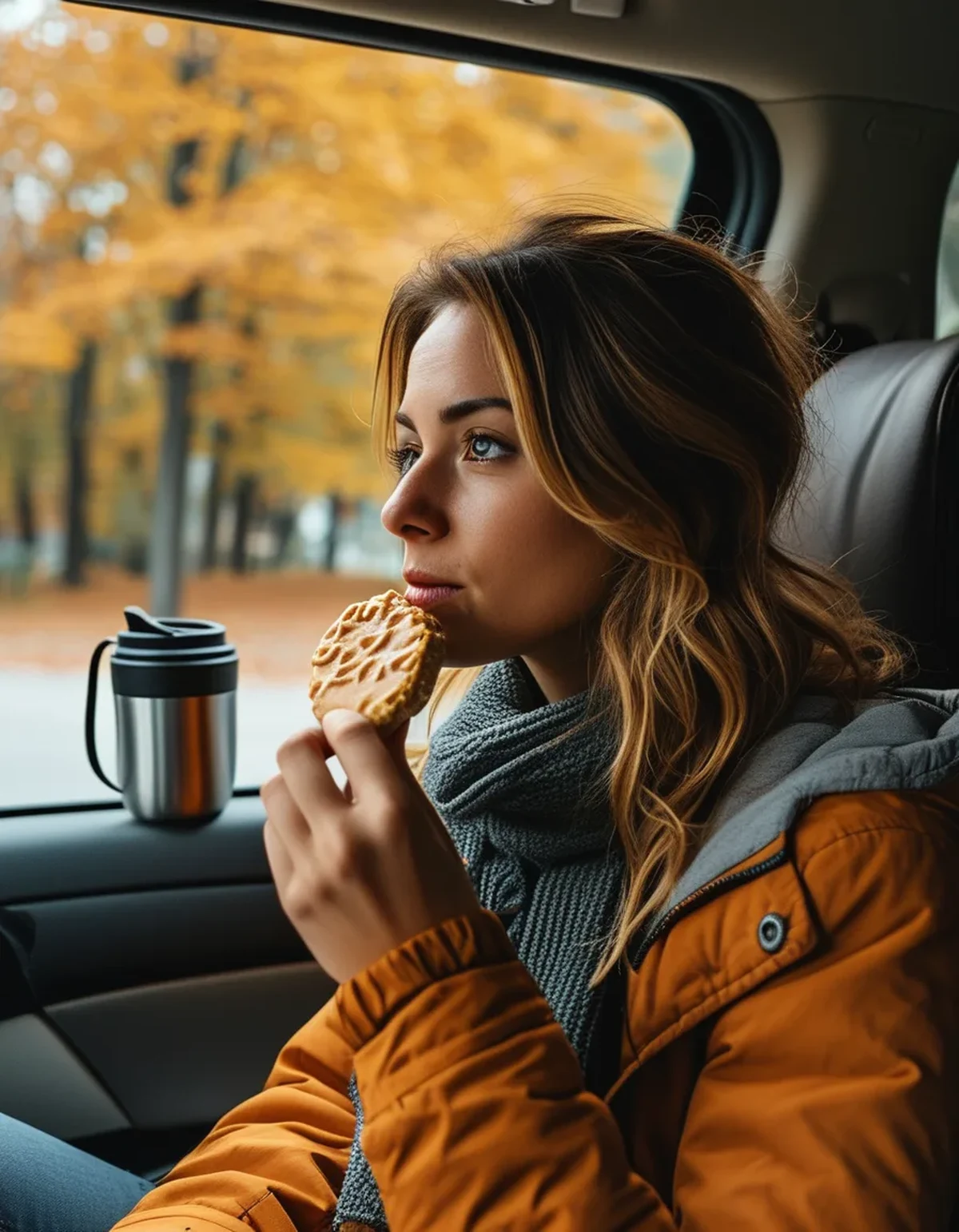
Water alongside a bar adds stomach volume, which contributes directly to the stretch signal. It also naturally slows eating, because you pause to drink. Two effects for one action.
Most people eat a car bar with either nothing or a coffee. Coffee is fine, but it does not add much volume, and if it is a sweetened coffee it adds calories that do not help satiety.
The more specific issue is that bars high in fiber or sugar alcohols genuinely need water to sit comfortably. Eaten dry, they are the ones most likely to produce that heavy, bloated, unsettled feeling an hour later — which people usually attribute to the bar being bad rather than to the circumstances.
A reasonable rule: if the bar has more than 6g of fiber or any sugar alcohols, do not eat it without water. That covers most of the low-sugar, high-fiber category, which is exactly the category people keep in the car.
Keep a bottle where the bars are. The two belong together.
When is a car bar actually the right call?
It genuinely is, sometimes, and it is worth saying so rather than treating every convenience decision as a failure.
Good uses:
- Bridging a gap where the alternative is nothing for four hours.
- Before training, when you need fuel and do not need satiety.
- On a long drive where the alternative is a service station.
- After training, when you need protein to arrive and the timing beats the experience.
Poor uses:
- As a meal replacement when you will be at home in twenty minutes. This is the classic error — you spend the calories and then eat dinner anyway.
- As an afternoon hunger fix on a normal working day, where a table and five minutes are available.
- When you are eating it because it is there rather than because you are hungry, which the car encourages more than any other setting.
The honest test is whether you would have eaten it if it required stopping the car. If the answer is no, the bar is filling a boredom gap rather than a nutrition one.
What changes as we head into autumn?
Two practical things, and one of them is the reason your bar tastes different this month.
Temperature. Bars that were soft and sticky in a hot summer car are now firming up as temperatures drop. That is mostly good — a firmer bar chews longer and eats slower. But a bar left in a cold car overnight becomes genuinely hard, and cold bars taste noticeably less sweet and more chalky. Bringing it inside or holding it for a few minutes fixes it.
Timing. Darker evenings shift dinner earlier for a lot of people, which shortens the gap the afternoon bar is supposed to bridge. A bar that made sense when dinner was at 8pm makes less sense when dinner has drifted to 6:30. Re-examine whether the afternoon bar is still doing a job or has just become habit.
There is also a stocking issue. Bars kept in a car through summer heat degrade — the coating blooms, the texture changes, and the taste goes off. Late summer is the right moment to clear out whatever has been living in the glovebox since June and restock.
A bar that has been through three months of car temperatures is not a bar you want to judge the brand by.
FAQ: Bars On The Go, Answered
Does eating slowly really make that much difference?
For satiety, yes — it is one of the better-supported findings in eating behavior research. For absorption, no. The protein is absorbed either way. What changes is how full you feel and what you eat afterward.
Is a shake better than a bar in the car?
For convenience, yes. For satiety, usually worse — liquid calories register less strongly than solid ones, and a shake is often finished even faster. If satiety is the goal, the bar is the better of the two.
Should I just eat half?
That works well for the boredom-eating case, and poorly for the genuine-gap case where half a bar will not bridge four hours. Decide which situation you are in before you decide the portion.
Why am I hungrier after a bar than after real food with the same protein?
Usually a combination of speed, low volume, and low chewing demand. A bar is calorically dense and physically small, so it produces less stomach stretch than the same protein in whole food form. That is a structural property of bars, not a fault in any particular brand.
TL;DR:
- The same bar satisfies less in a car because you eat it faster, chew it less, and pay it no attention — satiety needs all three.
- Under two minutes and the satiety signal never arrives; four to six minutes is what the bar was designed around.
- Soft, coated, easy-to-eat bars are the least satisfying, and they are exactly the ones people keep in the car.
- Water alongside adds stomach volume and slows you down — and it is essential for high-fiber or sugar-alcohol bars.
- Cooler weather firms bars up (good) and shifts dinner earlier (worth re-examining whether the afternoon bar still has a job).
None of this is an argument against bars. It is an argument for treating a bar as a small meal rather than a thing you consume between traffic lights. Park for five minutes, drink some water with it, and the same wrapper does a considerably better job than it did yesterday.
Keep Reading
This article is for general informational purposes only and is not medical advice. Always consult a qualified health professional for guidance specific to you.