Why the Same Protein Bar Behaves Completely Differently at Different Times of Day
Quick Answer: Protein bars are usually formulated for fast, convenient calories, which suits post-workout but works poorly as a meal replacement or an afternoon hunger fix. The variables that decide how a bar behaves are its protein-to-sugar ratio, its fibre content and its fat content - not the number on the front. For satiety, look for at least 15 grams of protein, at least 5 grams of fibre and under 10 grams of added sugar, and expect a bar to hold you for about 90 minutes rather than three hours.
The bar works after training and leaves you raiding the kitchen at 4pm.
Same bar, different job, and it was only designed for one of them.

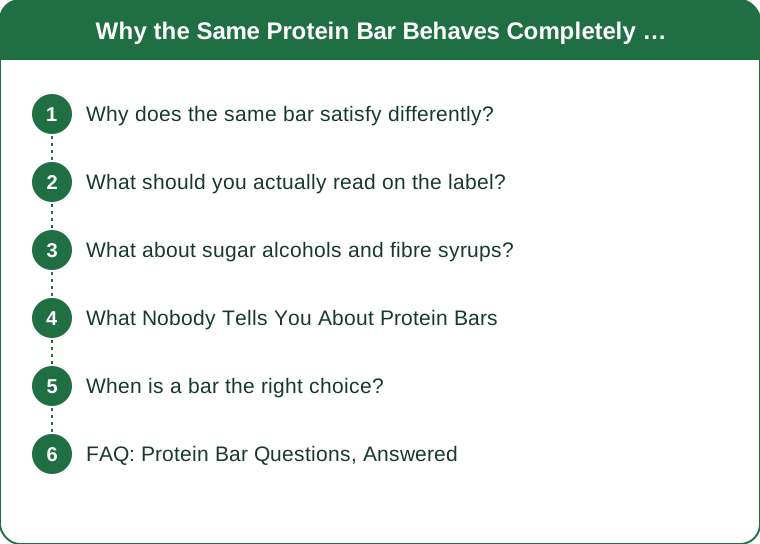
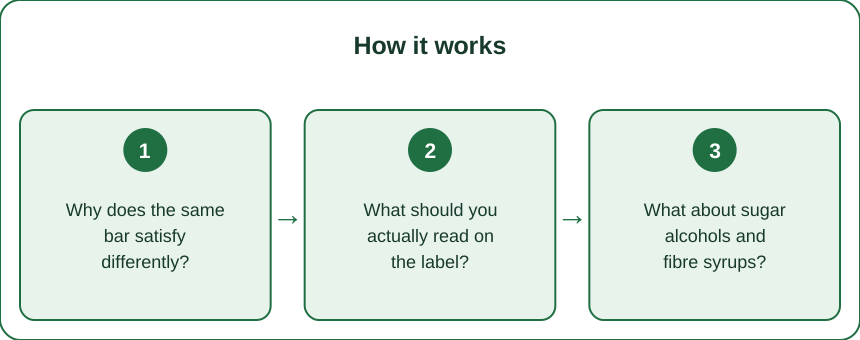
Why does the same bar satisfy differently?
Satiety depends on protein, fibre, fat and volume, and protein bars are dense and small - low volume for their calories, which works against fullness.
Post-workout, you are replenishing rather than seeking satiety, so a fast-digesting bar does exactly what you want.
As an afternoon snack, you are seeking satiety, and a bar built around fast carbohydrate and hydrolysed protein delivers a quick rise and a matching fall.
Fat slows gastric emptying and is what makes a nut-based bar hold you far longer than a low-fat one of identical calories.
Fibre adds volume and slows digestion, and it is the most commonly under-provided ingredient in the category.
And liquid or soft textures empty from the stomach faster than firm ones, which is why a chewy dense bar outperforms a soft one at the same macros.
What should you actually read on the label?
Protein: at least 15 grams, and ideally 20 for a bar doing meal-adjacent work.
Fibre: at least 5 grams, which is the number most bars fail.
Added sugar: under about 10 grams for a satiety bar; more is acceptable in a purely post-workout context.
Fat: 8 to 15 grams from whole-food sources if you want it to hold you. Very low fat bars are fast-acting by design.
Ingredient list length and order - the first three ingredients tell you what the bar mostly is, and if sugar or a syrup is among them, that is the bar.
Protein source matters somewhat. Whey and milk protein digest fast; casein, soy and pea slower. Collagen is not a complete protein and should not be counted toward a protein target.
And the calorie number relative to its job. A 400-calorie bar is a small meal; a 180-calorie bar is a snack. Both are fine, and confusing them is where the problem starts.
What about sugar alcohols and fibre syrups?
Sugar alcohols - erythritol, maltitol, xylitol - are what let a bar be low in sugar and still sweet, and they are why many people get digestive symptoms from protein bars.
Maltitol is the worst offender for gas and bloating and is common in cheaper bars.
Erythritol is generally the best tolerated because most of it is absorbed and excreted rather than fermented in the gut.
Isomalto-oligosaccharide (IMO) syrup is widely used as fibre and its actual fibre behaviour is disputed - it may act more like sugar than the label suggests.
Soluble corn fibre and chicory root inulin are genuine fibres, and inulin in particular causes gas in sensitive people at bar-sized doses.
Symptoms are dose-dependent, so one bar may be fine and two are not.
And if a bar consistently causes symptoms, check for maltitol and inulin first - those two explain most cases. This is general information, not medical advice.

What Nobody Tells You About Protein Bars
A bar is roughly the same thing as a candy bar with added protein powder, and that is not automatically bad - it means judging it by what it is rather than by what the packaging implies.
Cost per gram of protein is often three to five times that of whole food. A bar delivering 20 grams frequently costs more than a can of tuna, a tub of yoghurt and an egg combined. Convenience is what you are buying, and it is a legitimate purchase.
Bars are optimised for shelf stability, which drives the ingredient list more than nutrition does. That is why sugar alcohols and syrups dominate.
Protein content on the label can include collagen, which lacks the amino acid profile to support muscle protein synthesis. Check whether collagen appears in the ingredients before trusting the front-of-pack number.
Bars are excellent for specific situations - travel, a long hike, a gap between meetings, the drive home from training. They are poor at replacing a meal you had time to eat.
A bar plus a piece of fruit outperforms two bars for both satiety and cost, because the fruit adds volume and water.
And homemade bars are genuinely easy - oats, protein powder, nut butter, dates, pressed into a tin and refrigerated. Cheaper, better fibre, and no sugar alcohols.
When is a bar the right choice?
Post-training when a real meal is more than an hour away - this is the clearest use case.
Travel days, where the alternative is airport food or nothing.
Long hikes and endurance activity, where dense portable calories are the point.
Between back-to-back commitments, as a bridge rather than a replacement.
As a deliberate dessert substitute, which is an honest and often useful use.
Not as a routine meal replacement, where the volume and micronutrient gap adds up over weeks.
And not as an afternoon hunger fix unless it is a high-fibre, higher-fat bar - otherwise Greek yoghurt, an apple with nut butter, or cottage cheese does the job better and cheaper.
FAQ: Protein Bar Questions, Answered
How much protein should a bar have?
At least 15 grams, and 20 for anything doing meal-adjacent work. Check whether collagen is included in that number - it does not support muscle protein synthesis the way complete proteins do.
Why do protein bars upset my stomach?
Usually sugar alcohols - maltitol especially - or inulin fibre at a large single dose. Look for erythritol instead, and check for chicory root in the ingredients.
Can protein bars replace a meal?
Occasionally, but not routinely. They are low in volume and micronutrients relative to a meal, and the gap accumulates over weeks.
Are expensive bars better?
Sometimes - better protein sources, better fibre, fewer sugar alcohols. But price tracks branding at least as much as formulation. Read the label rather than the price.
What is the best bar for satiety?
One with at least 15 grams of protein, at least 5 grams of genuine fibre, 8 to 15 grams of fat and a firm dense texture. Nut-based bars usually beat protein-isolate bars here.
Should I eat a bar before or after training?
After, generally, or 60 to 90 minutes before if you want it as fuel. Immediately before training, a dense high-fibre bar often sits uncomfortably.
TL;DR:
- Bars are formulated for fast convenient calories, which suits post-workout and fails as an afternoon hunger fix.
- For satiety look for 15g+ protein, 5g+ fibre, under 10g added sugar, and 8 to 15g fat.
- Sugar alcohols - especially maltitol - and inulin explain most protein bar digestive complaints.
- Collagen counted in the protein number does not support muscle protein synthesis; check the ingredients.
- Cost per gram of protein is often three to five times whole food - you are buying convenience, which is fine.
- A bar plus a piece of fruit beats two bars, for satiety and for cost.
Expect about 90 minutes of fullness from a bar, not three hours. This is general information, not medical advice.
Keep Reading
This article is for general informational purposes only and is not medical advice. Always consult a qualified health professional for guidance specific to you.