The Protein Number Is Not What Decides If a Bar Works
Quick Answer: Match the calorie count to the job. A between-meals snack works at 180 to 250 calories; a meal replacement needs 350 to 450 and more than 20 grams of protein. Choosing a 400 calorie bar as a 3pm snack is the single most common reason people find that bars derail their intake.
You picked the one with the highest protein number, because that was the point.
It also had 390 calories, which is a small lunch, and you ate it two hours before dinner.
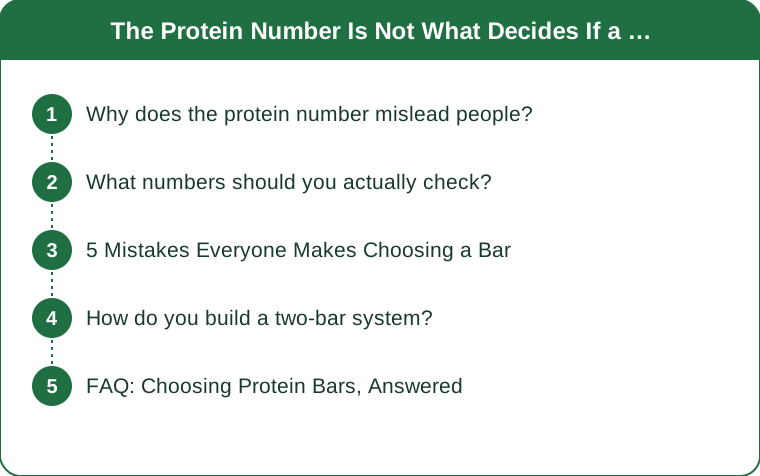
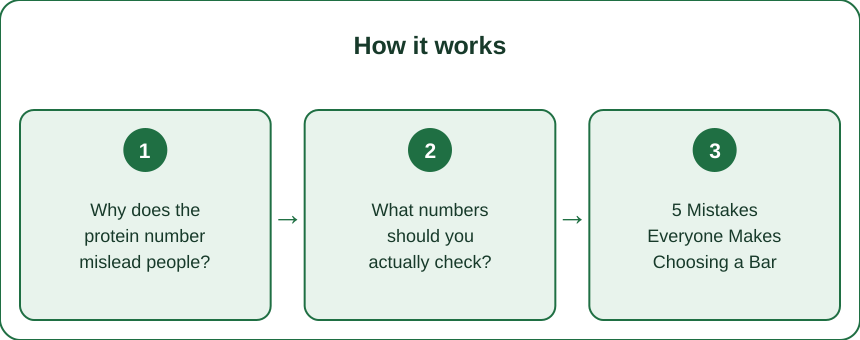
Why does the protein number mislead people?
Because it is the only number on the front, and it does not answer the question you actually have.
Protein grams say nothing about total energy. A bar can reach 20 grams of protein via a lean isolate at 190 calories or via nuts, chocolate coating, and syrup at 400. Both labels say 20 grams in the same size type.
Marketing selects for the protein number because it is the one people compare. Bar formulation is a trade-off between protein, texture, and palatability. The most palatable route to a high protein number usually involves added fat and sugar, and the front of the package will not tell you which route was taken.
Snacking is about the gap, not about the protein. A mid-afternoon snack exists to hold you for three hours. Whether that works is decided by total calories, fiber, and fat — protein contributes, but is not the whole answer.
The same bar can be right and wrong on different days. A 400 calorie bar after a long training session is a good decision. The identical bar at a desk on a rest day is a quarter of your day’s energy for a snack.
Portion signals are absent. A bar looks like a snack regardless of what is in it, and the physical size gives you no calorie information at all. This is the exact opposite of how we judge most other foods.
What numbers should you actually check?
Four, in this order, and it takes ten seconds once you know them.
Calories first, always. 180 to 250 for a snack. 300 to 350 for a pre-training top-up. 350 to 450 for a genuine meal replacement. Decide the job first, then read this number.
Protein as a percentage of calories. Divide protein grams by calories and multiply by 40. Above 30 percent means the protein is doing the work; below 20 percent means you are eating a snack bar with protein added.
Fiber, aiming for 5 grams or more. Fiber is what determines whether you are hungry again in 90 minutes. It matters more than protein for how long a snack holds, and it is usually printed in a smaller font.
Sugar alcohols if your gut is sensitive. More than 10 grams of maltitol or similar is where most people notice consequences. Erythritol is generally better tolerated than maltitol at the same amount.
Then the first ingredient, as a sanity check. If it is a syrup, chocolate, or a date paste, you are holding a confection with protein in it. That can be exactly the right choice — but it should be a choice.

5 Mistakes Everyone Makes Choosing a Bar
1. Buying one type for every situation. The pre-workout bar and the desk-drawer bar have opposite requirements — one wants fast carbohydrate and low fiber, the other wants the reverse. One bar cannot do both, and trying makes both worse.
2. Treating a meal replacement bar as a snack. The commonest and most consequential error. A 420 calorie bar eaten as an addition rather than a replacement adds up to a substantial weekly surplus.
3. Ignoring fiber entirely. People compare protein between two bars and never look at the number that decides whether they are hungry at 4:30.
4. Buying in bulk before testing one. Texture, sweetness, and gut tolerance vary enormously between brands at identical macros. Buy one, wait a day, then commit — the fourth mistake is the expensive one and it happens in every warehouse store.
5. Forgetting where it will actually live. A bar that spends the autumn in a car door goes hard and unappetizing; one in a warm bag melts through its coating. Storage conditions decide whether you eat it, and an uneaten bar has no macros at all.
How do you build a two-bar system?
Keep exactly two types and assign each a job.
Bar one — the snack: 180 to 250 calories, 12 to 15 grams protein, 6 or more grams fiber. This lives in your bag and your desk. It fills a gap without becoming a meal.
Bar two — the replacement: 350 to 450 calories, 20 or more grams protein, some carbohydrate. This lives where you might genuinely miss a meal: the car, the gym bag, the office drawer for late days.
Label them in your head by situation, not by brand. The three-hour-gap bar and the missed-lunch bar. Naming the job is what stops the wrong one from being eaten out of proximity.
Re-check the labels every six months. Reformulations are common and rarely announced. A bar you chose two years ago for its fiber may have quietly lost 3 grams of it.
Compare against what you would otherwise eat. A bar is not competing with an ideal meal; it is competing with what actually happens at 3pm when there is nothing prepared. Judged against that, a well-chosen bar is a good outcome.
FAQ: Choosing Protein Bars, Answered
How many calories should a protein bar have?
It depends on the job: 180 to 250 for a between-meals snack, 300 to 350 before training, and 350 to 450 if it is genuinely replacing a meal. There is no correct number in the abstract — which is exactly why the front-of-package protein figure is such a poor guide.
Is a bar with more protein always better?
No. Above roughly 20 grams in a single bar, the additional protein exceeds what most people need at once, and manufacturers usually reach those numbers by adding calories. Protein as a percentage of total calories is a far more useful comparison than the raw gram figure.
Why am I hungry an hour after a protein bar?
Almost always low fiber, sometimes low total calories. A 200 calorie bar with 2 grams of fiber empties quickly; the same calories with 8 grams of fiber holds far longer. Check the fiber line before you conclude the protein number was too low.
TL;DR:
- Decide the bar’s job first — snack, pre-training, or meal replacement — then read the calorie number.
- Protein as a percentage of calories beats raw grams: above 30 percent is a protein bar, below 20 percent is a candy bar.
- Fiber at 5 grams or more decides how long it holds you, and it is the line people never read.
- Keep two types with assigned jobs rather than one type for everything.
The protein number is on the front because it sells. The calorie and fiber numbers are on the back because they are the ones that decide whether the bar works.
Keep Reading
This article is for general informational purposes only and is not medical advice. Always consult a qualified health professional for guidance specific to you.