Why What You Drink With a Protein Bar Changes How It Sits
Quick Answer: Protein bars are dense, dry, and often high in fiber and sugar alcohols, all of which need water to move through the digestive tract comfortably. Eating one with plenty of water helps the fiber hydrate and the bar break apart. Eating one with coffee alone tends to make it sit heavier, because caffeine speeds gut motility while the dry, fibrous mass has not softened, and coffee provides less useful hydration than plain water for this purpose.
The fix costs nothing: a glass of water alongside, not instead of, whatever else you are drinking.

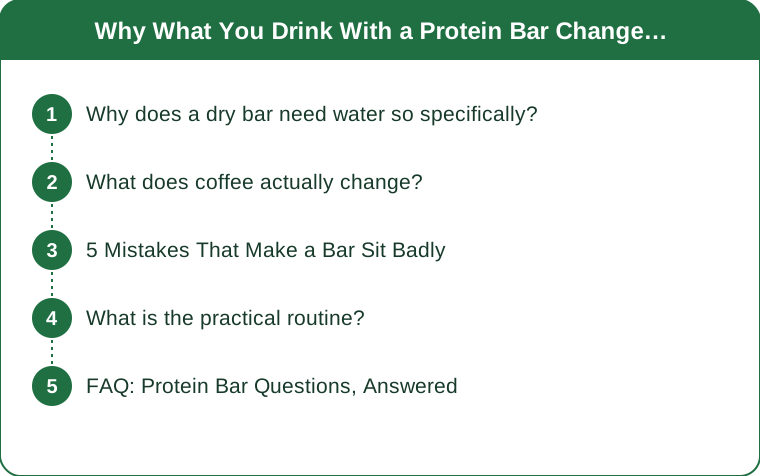
Why does a dry bar need water so specifically?
Because most of what makes a protein bar chewy also makes it slow to break down.
A protein bar is engineered to be shelf-stable, which means low moisture. Low moisture is why it does not spoil and why it has that dense, compressed texture. When it reaches your stomach, it has to absorb liquid before digestion can really begin, and it will take that liquid from whatever is available.
The fiber compounds this. Most protein bars contain substantial added fiber — chicory root fiber, inulin, soluble corn fiber, resistant starches. Soluble fibers work by absorbing water and forming a gel. That gel is what produces the satiety and the digestive benefits, and it can only form if there is water to absorb.
Eat a high-fiber bar with insufficient fluid and the fiber pulls water from the digestive tract itself rather than from your drink. The result is the heavy, brick-like sensation people describe, and for some people, cramping or bloating an hour or two later.
Sugar alcohols add a third layer. Maltitol, erythritol, and their relatives are poorly absorbed by design, which is what keeps the calorie count low. They draw water into the intestine osmotically, which is the mechanism behind the digestive complaints these ingredients are known for. Adequate fluid intake does not eliminate this and it does moderate how abruptly it happens.
So the bar arrives dry, the fiber wants water, and the sugar alcohols move water around. A glass of water alongside addresses all three at once.
What does coffee actually change?
Two things, in opposite directions, and the net effect depends on the bar.
Caffeine increases gut motility. It stimulates contractions in the colon and generally speeds transit. For a well-hydrated, moderate-fiber meal that is unremarkable. For a dense bar that has not yet broken down, it means moving a partially processed mass along faster than it is ready to move.
Coffee is also acidic, and on an empty stomach it stimulates acid production. Combined with a dense protein and fat load, some people experience this as the bar sitting heavily or as reflux.
The hydration question is more nuanced than the old advice suggests. Coffee is not meaningfully dehydrating at ordinary intakes — the fluid in it counts toward your daily total. But it is not the same as water for the specific job of hydrating fiber, largely because people drink a small volume of coffee slowly while a bar needs a decent volume of fluid at roughly the same time.
There is also a timing effect that gets overlooked. The morning coffee-and-bar combination often replaces breakfast entirely, which means a dense, fibrous, sugar-alcohol-containing food is the first thing hitting a stomach that has been empty overnight. That is the highest-difficulty version of the situation, and it is also the most common one.
None of this makes coffee and a bar a bad combination. It makes water alongside the sensible addition, and it explains why the same bar behaves differently at a desk in the morning and in a gym bag in the afternoon.

5 Mistakes That Make a Bar Sit Badly
Eating it with no fluid at all. The most common version, usually in a car or between meetings. The fiber will find water somewhere, and taking it from your gut is the uncomfortable route.
Eating it fast. A bar takes about 90 seconds to eat and the same amount of food as a small meal. Chewing thoroughly does a meaningful share of the mechanical breakdown that the stomach otherwise has to do on a dense, dry mass.
Pairing a high sugar alcohol bar with a large coffee on an empty stomach. This stacks every variable in the wrong direction — osmotic water movement, increased motility, acid on empty. If a bar has ever produced dramatic results for you, this combination was probably involved.
Using a high-fiber bar as a pre-workout. Fiber and exercise are a poor pairing, because blood flow shifts away from digestion during exercise and undigested fiber sits there. A lower-fiber bar 60 to 90 minutes before is a very different experience.
Assuming the bar that works in winter works in August. Heat changes both the bar’s texture and your hydration status, and a bar eaten while already slightly dehydrated after a hot walk is working with less fluid to begin with. The third mistake surprises people most, because they blame the bar’s brand rather than the coffee it arrived with.
What is the practical routine?
Four adjustments, in order of how much difference they make.
Drink a glass of water with it — about 250 to 350 ml, alongside, not after. This is the entire fix for most people. It gives the fiber something to hydrate with and helps the dense mass break apart.
Have the coffee, and have it after rather than during. Finishing the bar first means the initial breakdown happens before motility speeds up. It also stops you using coffee as the swallowing fluid, which is what leads to under-hydrating the bar.
Check the fiber and sugar alcohol content of your usual bar. Anything over about 8 grams of fiber or containing maltitol high in the ingredient list is a bar that demands more water than average. That is not a reason to avoid it — it is a reason to plan the fluid.
Match the bar to the context. High fiber and high protein for a desk day when the bar is genuinely replacing a meal and you have water to hand. Lower fiber, simpler formulation for before training or on the move.
In late summer, one additional consideration is worth flagging. You are likely running at a lower baseline hydration than you think after being outdoors in heat, and a bar eaten in that state has less fluid available to work with. The version of this that catches people out is the post-walk or post-run bar on a hot afternoon — the bar is fine, the timing is fine, and there simply is not enough water in the system.
This is general nutrition information, not medical advice. Persistent digestive discomfort, especially if it is new or severe, is worth discussing with a professional rather than solving with a different bar.
FAQ: Protein Bar Questions, Answered
How much water is enough with a bar?
Roughly a standard glass — 250 to 350 ml — consumed around the same time as the bar. More matters less than the timing; a glass afterward is less effective than a glass alongside.
Does milk work as well as water?
Better in some ways, because it adds protein and slows gastric emptying, which many people find sits more comfortably. It is a heavier option overall, so it suits a meal replacement more than a snack.
Why does the same bar feel fine some days and heavy others?
Usually hydration status, how empty your stomach was, and what you drank with it. Those three explain far more day-to-day variation than anything about the bar itself.
TL;DR:
- Protein bars are dry and high in fiber, and fiber needs water to gel; without it, it draws water from your gut instead.
- Sugar alcohols move water into the intestine, which compounds the effect.
- Coffee speeds gut motility and is a poor hydration partner for a dense bar, especially on an empty stomach.
- Drink a glass of water alongside the bar and have the coffee after — that is the whole fix.
Try the water-alongside version tomorrow morning. If your usual bar has been sitting heavy, this is the cheapest thing to rule out.
Keep Reading
This article is for general informational purposes only and is not medical advice. Always consult a qualified health professional for guidance specific to you.