Why Your Protein Bar Tastes Sweeter When You're Tired
Quick Answer: Taste perception shifts with sleep, hydration, temperature, and how recently you ate. Poor sleep and dehydration both reliably increase sweetness perception and reduce sensitivity to bitterness, which is why the same bar reads as sickly on a bad morning and perfectly balanced on a good one.
You have eaten this bar three times a week for two months. Today it tastes like frosting. Nothing about the bar changed, which means the interesting question is what changed about you.

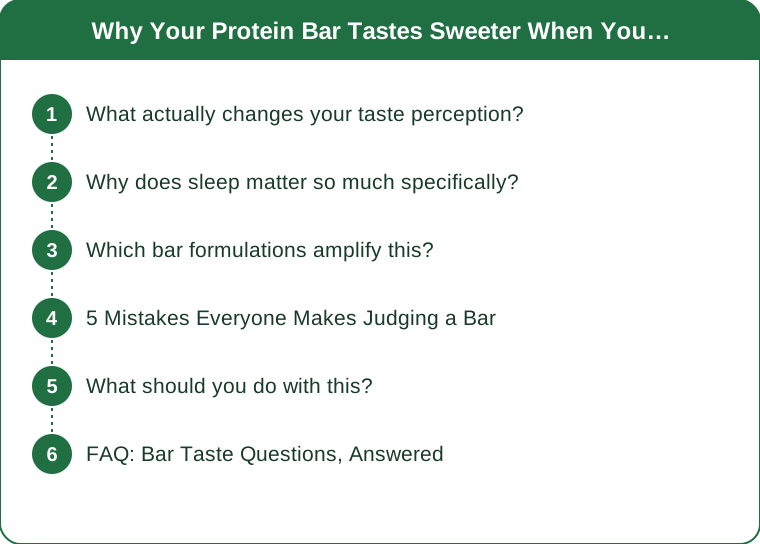
What actually changes your taste perception?
More things than most people expect, and several of them vary day to day.
Sleep. Short sleep reliably alters food perception and reward response. People who are underslept rate sweet foods as more appealing and tend to seek them out more, and there is reasonable evidence that sweetness intensity perception shifts too.
Hydration. A dry mouth concentrates whatever flavor compounds are present, because saliva is the medium that dissolves and distributes them. Dehydrated, you get a more intense and less balanced version of the same flavor.
Recent eating. Taste is comparative. A bar eaten after black coffee tastes dramatically sweeter than the same bar after a sweet smoothie — this is straightforward sensory adaptation, and it is why the second bar of a day always tastes different from the first.
Temperature. Sweetness perception peaks around body temperature and drops when food is cold. A bar from a cold bag tastes less sweet and more chalky; the same bar warm from a pocket tastes sweeter and softer.
Time of day. Taste sensitivity varies across the day for most people, generally lower in the early morning, which is precisely when a lot of bars get eaten.
Why does sleep matter so much specifically?
Because it affects both the sensory side and the reward side, and they compound.
On the sensory side, short sleep appears to shift detection thresholds. On the reward side — the better-documented half — sleep restriction increases activity in brain regions associated with food reward and decreases activity in areas involved in evaluating appropriateness. The food does not just taste different; it matters more.
The hormonal picture points the same direction. Sleep restriction is consistently associated with increased ghrelin, which promotes appetite, and decreased leptin, which signals satiety. The net effect is more hunger, stronger pull toward energy-dense sweet foods, and less of the internal brake that would normally stop you.
This has a practical implication that goes beyond taste. On a poorly slept day, a protein bar is more likely to become the first of three than the only one, and that is worth knowing before you unwrap it. Not because one bar is a problem, but because the day it tastes best is the day it is least likely to be the last thing you reach for.
Which bar formulations amplify this?
Some ingredients are much more state-dependent than others.
- Sugar alcohols — erythritol, maltitol, sorbitol — have a cooling mouthfeel and a sweetness that many people perceive as sharper when dehydrated. They also carry the well-known digestive downside at higher doses
- High-intensity sweeteners — sucralose, stevia, monk fruit — have long, lingering profiles and a bitterness on the tail that becomes much more noticeable when you are sensitive and much less noticeable when you are not. This is why the same stevia-sweetened bar is polarizing across days for a single person
- Whey isolate versus plant protein. Plant proteins carry more inherent bitterness, which some formulations mask with extra sweetness. When your bitter sensitivity is blunted, the masking sweetness is left exposed
- Coatings. A yogurt or chocolate coating is the sweetest component and the first thing your tongue meets, which sets the reference for everything that follows
A practical read: if a bar tastes wildly different day to day, it is usually heavily sweetened with a blend, and a more simply formulated bar will be more consistent even if it is less exciting on a good day.

5 Mistakes Everyone Makes Judging a Bar
-
Trying a new bar on an empty stomach first thing. Morning sensitivity is at its lowest and hunger raises appeal, so the first impression is unusually generous. Try it mid-afternoon before committing to a box.
-
Judging it straight from a cold car or bag. Cold suppresses sweetness and hardens texture, and cold is not how the product was formulated to be eaten. Give it ten minutes in your hand.
-
Comparing it to what you just drank. A bar after coffee and a bar after a sweet drink are two different products. Rinse with water first if you actually want to evaluate it.
-
Buying twelve after one good experience. The good experience may have been a well-slept, well-hydrated Tuesday. The third mistake is why people end up with a box of something they now dislike.
-
Blaming the batch. Reformulations do happen and are worth checking on the label. But if the bar is inconsistent for you and consistent for everyone else in your house, the variable is not the manufacturing.
What should you do with this?
Two useful applications, one practical and one bigger.
Practical: use it as a signal. If your usual bar suddenly tastes cloying, that is reasonably good evidence you are underslept, dehydrated, or both. It is a free, zero-effort daily reading on your own state, and it is often more honest than how you would answer if asked directly.
The response is simple: drink water first and eat it after. Much of the effect resolves within a few minutes of rehydrating, and you will get a more accurate read on whether you actually want it.
Bigger: adjust what you keep on hand for bad weeks. Sleep is not always fixable in the short run, but food environment is. On weeks you know will be short on sleep:
- Keep less sweet, higher-protein options available — bars that lean savory or nut-forward, or non-bar options entirely
- Front-load protein at breakfast, since the reward pull is strongest when protein intake is low
- Notice that the bar tasting amazing is information, not a recommendation
None of this makes protein bars a problem. It just means the bar is a better tool when you know which day you are having.
FAQ: Bar Taste Questions, Answered
Does taste really change that much, or am I imagining it?
The effects are real and reasonably well documented for hydration, temperature, sensory adaptation, and time of day. The sleep-taste link is better established on the reward and appetite side than on pure detection thresholds, but the practical experience is the same either way.
Why does the same bar taste better after a workout?
Several things at once — you are warmer, often mildly dehydrated, your energy stores are lower, and the reward response to food is heightened. Post-workout is the single most flattering context in which to taste anything, which is worth remembering when a sample tastes incredible at the gym.
Can I recalibrate my sweetness perception?
To a degree, yes. People who reduce added sugar over several weeks commonly report that previously normal foods start tasting too sweet. It takes a few weeks rather than a few days, and it makes highly sweetened bars considerably less appealing afterward.
TL;DR:
- Sleep, hydration, temperature, and what you just ate all shift how sweet a bar tastes
- Short sleep raises both sweetness appeal and overall food reward, so the bar tastes better and matters more
- Heavily blended sweetener systems are the most state-dependent; simpler formulations taste more consistent
- Use the shift as a free daily signal — drink water first, then decide
The bar tasting different is not a defect in the bar or in you. It is one of the few pieces of feedback your body gives you for free, and it happens to arrive before you have finished eating.
Keep Reading
This article is for general informational purposes only and is not medical advice. Always consult a qualified health professional for guidance specific to you.